Scary Sky: A Typeface for Bold, Atmospheric Design
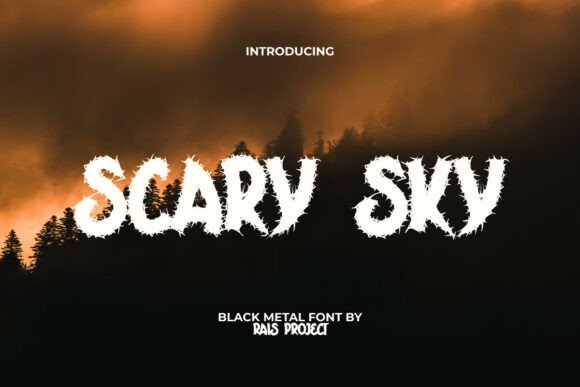
There are moments in design where you need more than just letters on a page—you need atmosphere. You need a typeface that doesn't just spell out a message but wraps it in fog, drips it in shadow, and sets it against a lightning-split backdrop. That's exactly where Scary Sky enters the picture. This black metal display font carries a distinctly eerie, raw energy that's hard to ignore, and for designers working on projects that demand a dramatic visual punch, it offers something genuinely different from the sea of clean, minimalist typefaces dominating today's landscape.
What Makes This Display Font Stand Out
Scary Sky isn't trying to be subtle. Its jagged letterforms, irregular edges, and aggressive styling draw directly from the visual language of black metal album art, horror movie posters, and underground zine culture. Every uppercase and lowercase character feels hand-carved—like someone etched the letters into wood or scratched them onto a tombstone. That rawness is precisely its strength. In a world saturated with polished sans serifs and elegant scripts, a typeface this unapologetically bold becomes a design asset that commands attention the moment someone sees it.
The font ships as a complete package: full uppercase and lowercase sets, numerals, and an extensive range of punctuation marks. That means you're not stuck cobbling together missing characters or settling for a limited character map. Whether you're typesetting a movie title, designing a festival poster, or creating packaging for a niche product line, the glyph coverage holds up across real-world applications.
Matching the Font to the Right Project
Not every project calls for a typeface this intense—and that's worth saying plainly. Scary Sky thrives in contexts where mood, edge, and visual drama are the goal. Think about the brands and industries where darkness, rebellion, and raw energy are selling points rather than drawbacks.
A clothing brand targeting fans of alternative fashion could use this font for hang tags, website headers, and social media campaigns. A horror-themed escape room might set its entire visual identity around a typeface like this—logo, signage, booking confirmation emails, even the staff uniforms. Independent game developers building atmospheric RPGs or survival horror titles would find it fits naturally into title screens, chapter headers, and promotional artwork.
Music-related projects are another obvious home. Band logos, album covers, gig posters, merchandise runs—these are spaces where a black metal display typeface doesn't just work; it feels expected. But the applications stretch further than you might initially consider. A craft brewery launching a limited-edition stout with a dark, gothic label design. A tattoo studio's booking page. A Halloween event's entire marketing kit. A podcast about true crime or the paranormal. The common thread is intentionality: the font needs to reinforce the story the project is already telling.
Practical Advice for Working with an Aggressive Typeface
Working with a display font as stylized as Scary Sky requires some care. Here are a few things worth keeping in mind before you drop it into your next design file.
Pair it wisely. A font this expressive doesn't need competition. Set your body copy in something quiet and legible—a clean sans serif like Inter, Open Sans, or even a simple serif like Lora. Let Scary Sky own the headlines and pull the eye. When two loud fonts fight for attention, nobody wins.
Watch your sizing. Display fonts are built for large-scale use—posters, headers, banners, logos. At small sizes, the intricate details in Scary Sky's letterforms can become muddy or illegible. Test it at the actual size it will appear in your final design, not just on a full-screen monitor where everything looks enormous.
Respect readability. There's a difference between "edgy" and "unreadable." If someone can't parse the word within a second or two, the design isn't working—no matter how cool the aesthetic is. Use Scary Sky for short, high-impact text. One to five words. A brand name. A tagline. A chapter title. Don't set a full paragraph in it and expect anyone to stick around.
Test across contexts. The font works across Adobe Illustrator, InDesign, Photoshop, CorelDRAW, and even Microsoft Word, on both Windows and Mac. That's a practical advantage worth noting. If you're designing a logo in Illustrator but your client needs to use the same font in Word documents for internal materials, compatibility matters. Install it, test it in the tools you actually use, and make sure the output matches your expectations.
Building a Brand Identity Around Dark Typography
Typography is one of the fastest ways to communicate brand personality. Before someone reads a single word on your website or product packaging, the typeface has already told them something. Scary Sky tells visitors: this brand is bold, unconventional, and unapologetically different. For the right business, that's not a risk—it's a competitive advantage.
Consider a small business owner launching a line of horror-themed candles. The product photos are moody and atmospheric. The scent names are evocative—things like "Witching Hour" and "Graveyard Moss." Dropping those names into a standard Helvetica layout would undercut the entire brand concept. Scary Sky, set against dark backgrounds with careful color choices, reinforces the world the brand is building. Every touchpoint—from the website hero image to the shipping label—feels cohesive.
That kind of visual consistency is what separates amateur branding from professional identity work. It's not about using one font everywhere; it's about choosing typography that serves the brand's story and deploying it strategically across all customer-facing materials.
Supporting Multiple Languages and Creative Workflows
One practical detail that sometimes gets overlooked: multilingual support. Scary Sky includes characters for multiple languages, which matters more than people realize. If your brand has an international audience, or if you're creating content in a language that uses accented characters or special diacritics, you need a font that won't break the moment you type an umlaut or a cedilla. This typeface handles that, which broadens its utility significantly for global projects, multilingual marketing campaigns, and international merchandise runs.
The font also plays nicely with the tools most creatives already rely on. Whether your workflow lives inside the Adobe Creative Suite, you prefer CorelDRAW for certain production tasks, or you need to share editable templates with clients who only have Word, the installation is straightforward and the compatibility is reliable. That kind of flexibility matters when you're managing real projects with real deadlines—not just making portfolio pieces.
Final Thoughts on Choosing Expressive Typography
The fonts you choose for a project do heavy lifting. They set tone before content, build recognition over time, and either reinforce or undermine your message. Scary Sky is a specialist tool—it won't work for a law firm's annual report or a pediatrician's waiting room signage. But for the projects it's built for, it delivers a level of atmospheric intensity that generic typefaces simply can't match.
If your work lives in the worlds of alternative fashion, horror entertainment, dark fantasy, underground music, gothic branding, or any creative space where edge and mood are assets, this font deserves a spot in your toolkit. Test it against your current project. Set your headline. See if the vibe clicks. Sometimes the right typeface doesn't just complete a design—it transforms it.