Run Clasher: The Glitchy Racing Font for High-Speed Projects
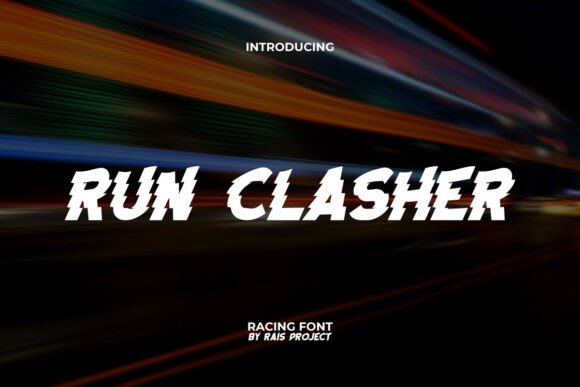
Every designer hits a wall eventually. You're staring at a blank canvas, trying to find a typeface that doesn't look like it belongs on a corporate memo or a wedding invitation. You need something with an edge—something that feels fast, modern, and unapologetically bold. That's where a font like Run Clasher enters the conversation. Created by RaisProject, this isn't your typical clean, safe typeface. It's a display font with a glitchy, speedy racing aesthetic that immediately injects energy into any design. If you're working on anything that needs to feel dynamic, competitive, or tech-forward, this is the kind of typography that can transform a flat layout into something with real visual momentum.
Where Speed Meets Style: The Visual Personality of Run Clasher
Run Clasher doesn't whisper—it shouts. The design leans into a racing vibe with sharp angles, condensed letterforms, and that signature glitch effect that gives it a digital, almost distorted edge. Think of the typography you'd see on a high-performance car decal, an esports logo, or a futuristic movie poster. It's all caps, which immediately gives it a commanding presence, and it includes a full set of numerals and punctuation, so you're not scrambling for missing characters mid-project.
What makes it particularly useful is its versatility within that bold personality. It works for automotive branding, sure, but also for gaming interfaces, fitness apparel, music festival posters, and even trendy café menus that want to feel more urban and less rustic. The glitch aesthetic taps into a broader design trend that blends retro digital culture with modern minimalism—something that resonates strongly with audiences aged 20 to 40 who grew up with pixel art and early internet visuals.
Practical Applications: More Than Just a Cool Look
A font's real value isn't just how it looks in a specimen sheet—it's how it performs across real projects. Run Clasher's bold, high-contrast design makes it a natural fit for logo design, where you need instant recognition and a strong silhouette. Pair it with a simple sans serif for body text, and you've got a brand identity that feels cohesive and intentional without being monotonous.
For packaging design, especially in industries like energy drinks, sports equipment, or streetwear, Run Clasher can do the heavy lifting on a product label. It grabs attention on a crowded shelf and communicates a sense of action and intensity. On social media graphics, where you have about two seconds to stop someone from scrolling, a glitchy, racing-inspired headline can make all the difference. It's the kind of typography that feels native to Instagram stories, YouTube thumbnails, and TikTok overlays.
But don't limit it to digital. Run Clasher works surprisingly well in print materials—posters for motorsport events, flyers for gaming tournaments, or even editorial layouts in magazines covering tech, fashion, or extreme sports. The font's structure holds up at larger sizes, which is exactly what you want from a display typeface. It's not trying to be a workhorse for body copy; it's designed to headline, to announce, to demand attention.
Font Pairing and Readability: Making It Work in Real Layouts
Here's the practical reality: a font like Run Clasher isn't meant to stand alone in every context. It's a specialty display font, which means pairing it wisely is essential. For body text, you'll want something clean and legible—a neutral sans serif or even a simple serif that doesn't compete for attention. Think of Run Clasher as the lead singer and your secondary font as the rhythm section. They need to complement each other without clashing.
Readability is always a consideration with stylized fonts. Run Clasher's all-caps design and glitch effects work best at larger sizes—headlines, banners, logos, and pull quotes. Avoid using it for paragraphs of text or fine print; that's not its purpose, and forcing it into that role will only frustrate your audience. Instead, let it shine where it's meant to: in moments of high impact and visual emphasis.
One practical tip: test your font pairings in context before committing. Mock up a social media post, a product label, or a website hero section and see how the typography feels at actual scale. Sometimes what looks great in a font preview doesn't translate to a real layout, and catching that early saves hours of revision later.
Compatibility and Licensing: The Boring (But Important) Stuff
Run Clasher comes with multilingual support, which is a genuine asset if you're working on projects for international audiences or clients. It's accessible in Adobe Creative Cloud apps like Illustrator, InDesign, and Photoshop, as well as Corel DRAW and even Microsoft Word. That cross-platform compatibility means you're not locked into a single workflow, which is especially helpful for small teams or solo creators who switch between tools depending on the project.
Installation is straightforward on both Windows and Mac, so you won't need a technical manual to get started. And because it's a premium font from a foundry like RaisProject, you're getting a professionally designed typeface with proper kerning, consistent weight, and thoughtful detailing—things you don't always find in free font alternatives.
Before using Run Clasher in any commercial project, always review the licensing terms. Most premium fonts come with specific usage rights—desktop, web, app, or broadcast—and understanding those terms upfront protects you legally and ensures the foundry gets fairly compensated for their work. It's a small step that makes a big difference in professional practice.
Final Thoughts: When to Choose a Font With Character
Not every project needs a font with this much personality. But when you're designing for an audience that values energy, speed, and a bit of digital grit, Run Clasher delivers. It's the kind of typeface that can define a brand's visual language, especially in competitive spaces like gaming, automotive, fitness, and streetwear. The key is knowing when to use it—and when to let a quieter font take the lead.
Think about your project's goals. Are you trying to communicate urgency? Innovation? Rebelliousness? If so, a glitchy racing display font might be exactly what your layout needs. Pair it thoughtfully, use it strategically, and you'll have a design asset that doesn't just look good—it works hard for your brand.