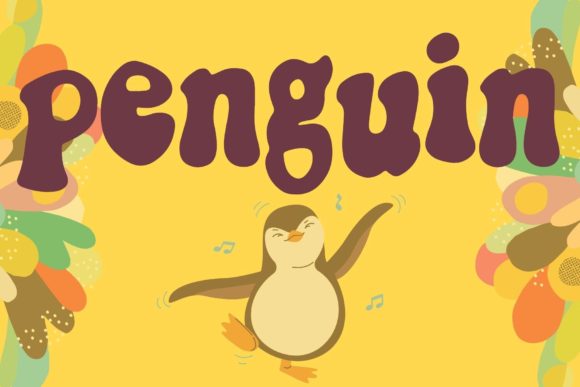
Penguin Font: A Playful Typeface for Brands That Want to Stand Out
Sometimes a project doesn't need to whisper—it needs to sing. You know the feeling: you're designing a logo, crafting a poster, or building out a brand identity, and the standard sans serif or classic serif just isn't cutting it. The text feels flat, forgettable, lost in a sea of sameness. That's exactly the kind of moment the Penguin typeface was made for. This isn't a font that fades into the background. It's a cute and jolly display font with enough personality to make any headline pop, any logo memorable, and any creative project feel genuinely alive.
What makes Penguin work so well is its inherent warmth. The letterforms carry a rounded, approachable quality—think friendly without being childish, playful without sacrificing clarity. It strikes a balance that's surprisingly hard to find in the world of display typography. You get character and charm without tipping into cartoonish territory, which means it can hold its own in professional contexts while still feeling inviting. For anyone building a brand that wants to feel human, approachable, and a little bit fun, this typeface delivers something most fonts simply can't.
Where Penguin Really Shines
Let's talk about practical applications, because that's where a font either proves its worth or collects digital dust. Penguin is built for logotype work first and foremost. If you're a small business owner launching a bakery, a kids' clothing line, a podcast, or a creative agency, a display font like this one can become the visual anchor of your entire brand identity. Imagine it stretched across your storefront signage, printed on your packaging, and featured in your Instagram headers. That kind of visual consistency is what turns a casual viewer into someone who actually remembers your name.
Beyond logos, Penguin holds up beautifully in headline contexts. Blog headers, magazine covers, poster titles, YouTube thumbnails, event invitations—anywhere you need a few words to grab attention and hold it. The letter shapes are distinctive enough to create interest but not so ornate that they become illegible at smaller sizes. That's a critical distinction. Plenty of creative fonts look gorgeous in a preview but fall apart the moment you try to use them in a real layout. Penguin avoids that trap.
For content creators and marketers, there's another angle worth considering: social media graphics. Platforms like Instagram and Pinterest are brutally visual. A post has maybe half a second to stop someone mid-scroll. Typography plays a huge role in that moment, and a font with Penguin's personality can be the difference between engagement and invisibility. Use it for quote graphics, story highlights, sale announcements, or branded templates. It photographs well, which sounds like a strange thing to say about a typeface, but anyone who's struggled with fonts that look great on screen and terrible in a screenshot knows exactly what that means.
Pairing Penguin With Other Fonts
Here's where things get interesting from a design perspective. Penguin is a display font, which means it's engineered for impact at larger sizes. It's not your body text. You wouldn't set a full paragraph in it—your readers' eyes would fatigue quickly, and the charm that makes it special would become overwhelming in extended passages. Instead, think of it as your headline partner, your accent font, your visual exclamation point.
The smart move is to pair it with something clean and readable for longer text. A simple sans serif like Montserrat, Open Sans, or Lato works beautifully alongside Penguin, letting the display font do the heavy lifting on headlines while the secondary typeface handles paragraphs, captions, and smaller UI elements. If your brand leans more editorial or classic, try pairing it with a modest serif—something like Lora or Merriweather can create a lovely contrast between playful and polished.
Test your pairings before committing. Set a headline in Penguin, drop your body text font beneath it, and look at the two together at actual size. Do they feel like they belong to the same family, even though they're clearly different? That's the sweet spot. You want contrast without conflict. The best font pairings feel like a conversation between two voices that complement each other, not two strangers shouting in the same room.
Thinking About Licensing and File Formats
This is the unsexy but essential part of working with any premium font. Before you download and start designing, make sure you understand the licensing terms. If you're using Penguin for a personal project—a birthday invitation, a school flyer, a hobby blog—the requirements are usually straightforward. But the moment money enters the picture, things shift. Commercial use typically requires a specific license, and that license might vary depending on whether you're using the font for a single client project, a product you're selling, or a brand identity that will appear across multiple platforms and print materials.
Read the license agreement. It sounds obvious, but you'd be surprised how many designers and small business owners skip this step and run into trouble later. Does the license cover web embedding? Can you use it in digital products like templates sold on Etsy or Creative Market? Is it cleared for merchandise—t-shirts, mugs, tote bags? These details matter, especially if you're building a business around your designs. A font that looks perfect but comes with restrictive licensing can become a liability instead of an asset.
Also pay attention to what's included in the download. A well-constructed display typeface often comes with multiple weights, stylistic alternates, ligatures, or even multilingual support. These extras aren't just bells and whistles—they expand your creative options significantly. Alternates can help you customize a logo so it doesn't look identical to someone else's use of the same font. Extended character sets let you work with international clients or audiences without hitting dead ends.
Making It Work for Your Brand
The real question with any typeface isn't whether it's objectively good—it's whether it's right for your specific project. Penguin fits naturally into brand identities that want to communicate warmth, creativity, and approachability. Think children's products, lifestyle brands, indie publishers, food and beverage packaging, event promotions, music artwork, gaming interfaces, and editorial layouts aimed at younger or more design-savvy audiences.
If your brand voice is serious, minimal, or ultra-corporate, this probably isn't your match. And that's fine. Not every font needs to serve every purpose. The goal is alignment between what your audience expects and what your visuals communicate. When those two things match, trust builds faster. Recognition comes easier. People engage more readily because nothing feels forced or incongruent.
Take the time to mock up a few real-world applications before committing Penguin to your final designs. Place it on a business card. Drop it onto a website header. See how it looks in a mobile screenshot. Print it out on actual paper. Typography that looks perfect in a design tool can surprise you in the physical world, and testing across contexts is the only way to catch those issues before your audience does.
Good design is about making intentional choices, and choosing a typeface is one of the most consequential decisions you'll make for any visual project. Penguin offers something specific—a personality, a mood, a feeling of cheerful confidence that's hard to replicate with more conventional fonts. Used thoughtfully, it becomes more than just lettering. It becomes part of how people experience and remember your work.